
| Our Publications | ||
| Books by Title | ||
| Books by Author | ||
| Books by Country | ||
| E-books | ||
| About | ||
| Orchid Press E-books | ||
| Distributed E-books | ||
| Our Bookshop | ||
| About Us | ||
| Browse Shop | ||
| How to Buy | ||
| Contact Us | ||
| WE BUY BOOKS AND LIBRARIES | ||
|
||
Book Reviews
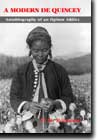
A Modern de Quincey:
Autobiography of an Opium Addict
byH. R. Robinson
2nd edition 2004. 152 pp., 5 b & w plates, 1 map, 215 x 152, Softcover
ISBN-10: 974-524-038-9 $23.00
ISBN-13: 978-974-524-038-4
Fortean Times Verdict: The most disreputable man in Mandalay rehabilitated
Book review by Phil Baker,
(The Fortean Times, September, 2005)
The banana is great… but the skin is greater, according to “the most disreputable man in Mandalay”, who blew his eyes out and had a death-defying tattoo.
Those were the days, when you could be the most disreputable Englishman in Mandalay. Captain Herbert Reginald Robinson was that man, although he didn’t really do anything we would disapprove of today. Robinson was a pukka Englishman who went native in Twenties Burma, and slid from being a colonial administrator to an opium smoker, a Buddhist monk, and finally a rock-bottom opium addict.
By March 1925 Robinson’s situation was desperate. Penniless and in debt, with his credit, his opium and his reputation all gone, he remembered his Kipling and his old service pistol, still packed in his trunk. “Just go to yer rifle and blow out yer brains,” ran the Kipling, “And go to yer Gawd like a soldier.”
And with these slightly misremembered words in his mind, Robinson did one of those things you must never, ever do: he put the gun to his temple and fired a freehand shot into his head. The next thing he knew, he was crawling around on the floor, and the colonial police were breaking the door down. He had succeeded only in blowing both eyes out.
Robinson never lost his Buddhist viewpoint, and this very calm and lucid autobiography is probably informed by the idea of Sammasati—“right mindfulness” or “right recollection”—as well as being patterned by meaningful coincidences, like the talismanic tattoo against death from bullets that he allowed an old man to give him. The overarching coincidence. a striking instance of the patterns life makes—and the meanings people find in it—comes when Robinson applies for his birth certificate, which he needs to retrain at the Massage School of the National Institute for the Blinc He discovers he was born in Burn Road, Stoke Newington, and the extraordinary story of his life falls into place like a strange, predestined journey.
There is some offbeat ethnographic interest when Robinson is a colonial magistrate among the Lisu people of northern Burma, and even has his night of passion with a girl accused of murdering her husband (who freely admits to him in private that she has done it) and there is plenty of “human interest” in the old journalistic sense. One of the most moving episodes comes when Robinson’s former houseboy, Ba Set, waits every day outside the hospital with flowers, but is never allowed in: “I never knew of this,” Robinson writes (he was told, in a letter to England), “and can you blame me if it hardened my heart against the Christian belief?”
Needless to say, the book also has a certain drug interest. Robinson doesn’t really dilate on the sensations of opium smoking, but he does write about the paraphernalia and circumstances, and he has his own spurious, drugilluminated secret of the Universe which deserves to take its place with the best of them (“Higamous hogamous, woman’s monogamous: Hogamous higamous, man is polygamous,” comes to mind, along with “If I stand on my tippy toes I can reach the ceiling”. Robinson’s insight into the riddle of existence was: “The banana is great, but the skin is greater.”
You might almost think this sensational story was a fabrication, but Robinson was certainly real. He was a friend of George Orwell, who reviewed the book on its first appearance in 1942 and wrote: “Those who knew Captain Robinson in the old days will be glad to receive this evidence of his continued existence.” It was through Orwell that I discovered Robinson, and at this point I should probably declare an interest. A couple of years ago, I nominated this rare and obscure book for a feature in the Guardian newspaper about unknown classics, and it was after reading the piece that Gerry Abbott very enterprisingly brought about this wonderful new edition.
I had been doing some research into Robinson’s later life, possibly towards a biography, and I can report that he became a physiotherapist in Tooting, worked through to retirement, and was living in Crowborough Road in March 1965 when, 41) years after his original attempt, he finally killed himself. I recently had the pleasure of talking to a woman who knew ‘Robbie’ in his south London years, and she remembered his philosophical approach to life and his sense of humour. In brief: this book is a terrific read; all royalties from the present edition go to Prospect Burma, an educational charity; and, last but not least, I would love to hear from anyone else who remembers Robinson.
[Read a review from The Nation] [Read a review from The South China Morning Post] [Read a review from The Guardian] [More Orchid Press Reviews]
PO Box 70, Trinity TB, NL, A0C 2S0, Canada
Telephone: +1 709-330-4703