
| Our Publications | ||
| Books by Title | ||
| Books by Author | ||
| Books by Country | ||
| E-books | ||
| About | ||
| Orchid Press E-books | ||
| Distributed E-books | ||
| Our Bookshop | ||
| About Us | ||
| Browse Shop | ||
| How to Buy | ||
| Contact Us | ||
| WE BUY BOOKS AND LIBRARIES | ||
|
||
Book Reviews
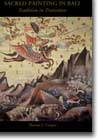
Sacred Painting in Bali:
Tradition in Transition
byThomas L. Cooper
2005. 192 pp., 96 col. pl., 2 maps, bibliography, index, 29 x 21 cm., hardcover.
ISBN-10: 974-524-034-6 $45.00
ISBN-13: 978-974-524-034-6
Book review by Hildred Geertz, Princeton University (American Anthropologist, March 2007, Vol. 109, No. 1, pp. 197-197)
Are the arts in Bali changing along with the massive transformations that Balinese society has undergone in the past century? Thomas Cooper gives us some materials for addressing the answer to that question. His book is an excellent record of an evanescent genre of paintings made by the Balinese for their own delectation. It is a study of the rapidly deteriorating decorations of temple altars, paintings that have been largely neglected by researchers. With brilliant color photographs and extensive interviews, Cooper adds another needed layer to our understanding of Bali’s rich plastic and performed arts.
The period covered is the middle of the 20th century through the 1990s. The geographic area is south central Bali, especially Gianyar, but it also includes parts of north Bali and far western Bali. Cooper took photographs of 2,000 paintings by 134 different painters. He personally visited 33 of the former and systematically interviewed 15 of the latter. These were painters working in the 1990s.
Cooper carefully defines his terms, keeping to concepts of “genre” and “style” as held by the Balinese. For instance, he makes a major distinction between art and painting. The first word echoes the Balinese term seni, which refers to “commercial paintings or ‘fine art’ (intended for sale in shops and galleries to foreign visitors)” (p. 4), while the second is an accurate translation of the term lukisan, which Balinese always use for those works destined for other uses, notably for temple ornamentation. He introduces the Western term traditional as a general category, specifically defined to cover those Balinese paintings that are the subject of his book. One criterion for inclusion in this category is a painting style “related to that of shadow puppets” (p. 5). The Dutch called it the wayang style. Another is that these paintings were made for “sacred” purposes. (I was glad to see that he never uses the misleading term folk art, which is in the title of Cooper’s earlier book [1998], written with Joseph Fischer, misleading in that Balinese society differs from European in that it has no “folk” to contrast to “literati” as such.)
Building further on the work of Anthony Forge (1979), Adrian Vickers (2005), and David Stuart Fox (1981), Cooper shows that the more well known Kamasan paintings are only a tip of the iceberg of traditional noncommercial painting. Few of the paintings shown here were made in Kamasan or in Kamasan style.
The notion of “transition” is stressed, but Cooper does not develop or illustrate the idea of a process of historical transformation in details and in larger sequences. He provides a rough contrast between the works made before 1945 and those of the 1990s. In his materials, one can see evidence of a general shift from the strict wayang style, which focuses on the figures alone, to an introduction of naturalistic backgrounds. In addition, one notices technical shifts from large cloth hangings to small wood and composition panels, from natural (earth or vegetable) paints to oils. Both of these changes can be traced to the emergence and characteristics of tourist art, since his painters all have their train¬ing, and indeed most of their livelihood, in the making of commercial painting, evidence that there is always at work a complex dialectic between commercial and sacred attitudes, a dialectic itself that is changing.
Cooper gives us, in this book, a solid basis for further research into that transition during the 21st century and into a deeper understanding of Balinese life.
REFERENCES CITED
Fischer, Joseph, and Thomas Cooper, 1998 The Folk Art of Bali. Kuala Lumpur: Oxford University Press.
Forge, Anthon, 1979 Balinese Traditional Paintings. Sydney: Australian National Museum.
Fox, David Stuart, 1981 “Pelukis Kerambitan yang Terlupakan.” Bali Pos, August 9,19, and 23.
Vickers, Adrian, 2005 Journeys of Desire. Leiden: KITLV Press.
[Read a review from the Journal of Folklore Research, Indiana University] [Read a review from the Asian Folklore Studies, Nanzan University, Nagoya] [Read a review from the Journal of Southeast Asian Studies] [Read a review from Anthropos] [More Orchid Press Reviews]
PO Box 70, Trinity TB, NL, A0C 2S0, Canada
Telephone: +1 709-330-4703